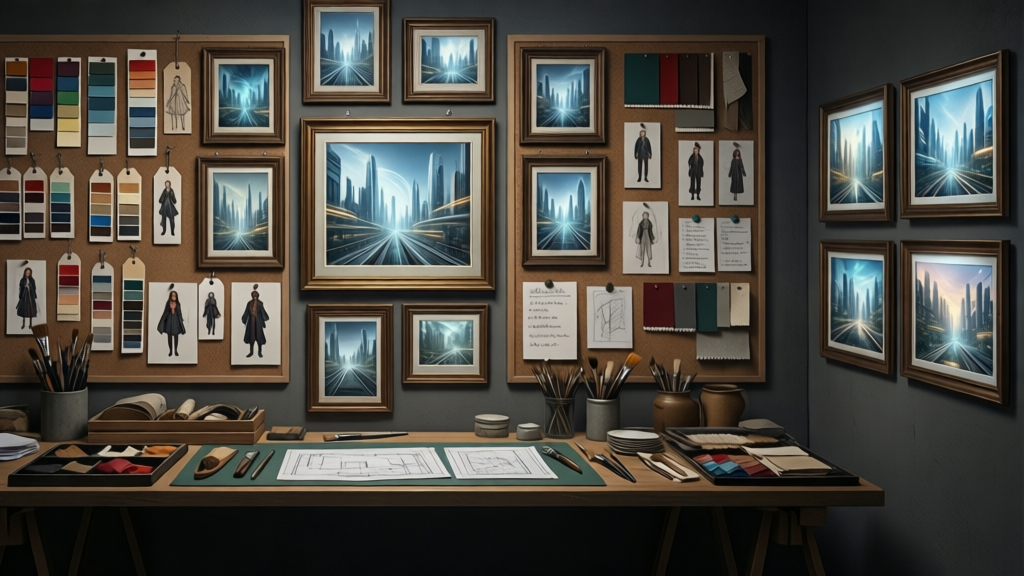
People still talk about image models as if they are weird cameras. The assumption sounds natural enough: type a prompt, press generate, and receive a picture the way a photographer receives a shot. That framing is everywhere, from product demos to casual arguments about whether synthetic images will “replace photography.” It is also the wrong mental model. A camera records a scene. An image model invents the scene, restages it, forgets half of it, and then invents it again. That is not camera behavior. That is art-department behavior.
The real problem in synthetic image work is continuity under revision. What matters is object persistence, spatial relationships, lighting logic, material rules, character identity, and memory across iterations. A camera does not manage those things. A production does. Someone has to decide what the room is made of, what color the hallway light should be, whether the same jacket still exists in frame four, whether the poster on the wall belongs to this world or drifted in from another one, and whether the machine on the desk is still the same machine after the angle changes.
A simple thought experiment makes the distinction obvious. Imagine an illustrated essay, a short motion package, or a product explainer that needs twelve related images. The goal is not twelve individually impressive pictures. The goal is twelve pictures that belong to the same visual civilization. The hallway in image eight should feel like it belongs to the building from image two. The object on the desk should not become a different species every time the camera “moves.” The mood can evolve, but the world has to hold. That is not a photography problem. It is a coordination problem.
This is why so many image-model interfaces feel stronger in the demo than in the workflow. The demo optimizes for the first gasp: a striking frame, a clever style transfer, a photoreal face conjured from nowhere. Real work begins one minute later, when someone asks for three more versions that keep the same object logic, or a wider scene that preserves the same spatial relationships, or a new composition that still looks like it came from the same campaign. At that point the system is not being graded as a camera. It is being graded as a department with continuity problems.
That also explains why prompt discourse so often turns into a dead end. Prompting matters, but it matters the way a note to an art department matters: as direction, not as total control. If the whole workflow still depends on one perfect paragraph typed into a blank box, the system is being asked to behave like a magic lens. Serious visual work needs reference sheets, character bibles, locked palettes, prop lists, texture rules, approved assets, and revision memory. The useful systems will be the ones that help teams manage those ingredients across time instead of restarting from a clean-room miracle on every generation.
This should change product design. The default interface for image generation should not be an empty prompt box plus infinite retries. It should look more like a continuity bench. Show the character sheet. Show the approved materials. Show the forbidden drift. Let users pin an object so it persists across scenes. Let them compare variants against a world-state baseline instead of against pure vibes. Expose lineage, not just outputs. A good system should help a team say: keep the concrete texture, lose the chrome rail, preserve the red transit icon, do not let the skyline drift into generic luxury sludge.
None of this makes image models cameras, and it does not make them substitutes for documentary or evidentiary photography. A documentary image is constrained by a scene that existed and can be testified to, checked, or disputed as a record. A synthetic image workflow is doing something else: maintaining an invented world well enough that it survives revision. That distinction matters, and keeping it clear makes the argument stronger, not weaker.
Once that boundary is clear, the replacement argument gets less theatrical and more useful. Image models will absorb some tasks that used to require photography, illustration, rendering, or compositing. But their most interesting role is not as fake cameras. It is as synthetic production partners for people who need worlds, not just frames. They are valuable when the job is visual logistics, coherence, and iteration at a speed most teams would struggle to match by hand.
The strongest systems, then, will not win by pretending to be perfect cameras. They will win by becoming reliable art departments with memory. The real magic is not that they can make one beautiful image from a sentence. It is that they can help build a visual world on purpose, keep it coherent under revision, and make every later frame cheaper because the world already has rules.